“What If”

Updated: Aug 7
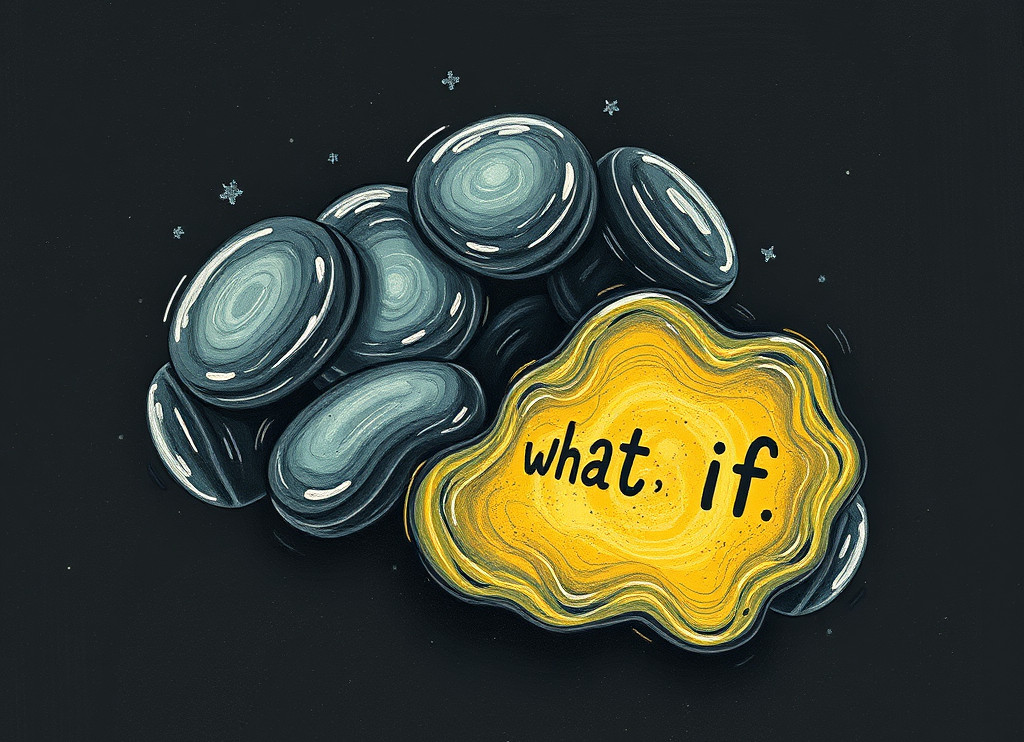
In my work as a psychologist in cancer care, I sit with moments when the mind begins to move ahead of what's actually happening — reaching toward what might come next.
These moments arrive at every stage of the experience. After a diagnosis, when the body that felt familiar has suddenly become something you watch with new attention. Between treatments, when you're waiting to see if it's working. After scans, after appointments, before scans, before appointments. And after treatment ends, in the long stretch where vigilance has no clear off-ramp.
Have you ever noticed how the mind moves in those moments?
It begins with two words:
What if.
What if it's back?
What if this pain means something?
What if the next scan shows bad news?
If these thoughts sound familiar, you're not unusual. They're an understandable response to living with uncertainty.
In my work with patients, I've come to notice that worry is less about what's happening medically in the moment and more about how the mind tries to manage uncertainty about the future—by predicting it.
When we look closely at what follows those two words — what if — two familiar patterns appear.
I give these patterns names: Protective Paula and Catastrophic Cathy. Both are trying to protect you.
Protective Paula sounds like this:
Let's go to follow-up appointments.
Let's pay attention to new symptoms.
That feels different. We should monitor it.
Paula helps us stay engaged in our care.
Catastrophic Cathy sounds different:
What if this is recurrence?
What if they missed something?
What if this time it's worse?
Cathy's strategy is anticipation. If she imagines the worst ahead of time, maybe you won't be blindsided. But anticipating the worst rarely reduces uncertainty. Instead, it teaches you to suffer in advance.
These thoughts can become louder in the days leading up to a scan. We call this scanxiety.
In those moments, Cathy may begin whispering:
This is the one.
You already know.
Start preparing.
Sleep becomes lighter. Anxiety rises. Your mind begins rehearsing worst-case scenarios.
This is normal. It's your mind doing its job, trying to protect something that matters.
These thoughts can also show up in the quietest moments.
I once worked with a patient who told me bedtime had become the hardest part of her day. During the day, she was steady — busy with work, friends, and the ordinary rhythm of life. But when the lights went out, and the room grew quiet, Cathy would show up:
What if it's back?
What if that ache meant something?
Soon, Protective Paula would join in, suggesting she review symptoms again or look something up online. She described feeling responsible, as if staying mentally vigilant was part of surviving.
What eventually helped wasn't answering the thoughts. It was learning to pause and say:
"This is bedtime, ladies. Chillax. There's no urgency to solve this right now."
Not because the fear wasn't real. But because nighttime isn't the moment to decide the future.
Even when a scan comes back clear, worry doesn't always disappear. It shifts into the space between appointments:
What if something is happening right now… and we don't know?
It helps to remember that your medical team's monitoring is designed with a specific goal: catching changes early — when they're still more like a smoldering ember, before they have the chance to become a three-alarm fire.
Early detection doesn't eliminate uncertainty. But it also means you're not watching alone. Your medical team is watching with you. And sharing that responsibility matters. It means you don't have to carry the entire burden of vigilance inside your own mind.
Sometimes Protective Paula begins working overtime — encouraging constant research, repeated body-checking, or endless reassurance seeking. At first, that can feel like you're being responsible. Over time, the goal shifts from staying informed to the impossible task of eliminating uncertainty altogether.
Cancer teaches what most of us would rather not learn: complete certainty is rarely possible. Both catastrophe and over-control are attempts to regain certainty.
And part of living alongside cancer is learning this:
certainty and uncertainty exist equally in life.
The work is learning how to live alongside the uncertainty.
When a "what if" thought appears, it can help to ask:
Who's talking right now?
Is it Catastrophic Cathy, turning possibility into certainty?
Is it Protective Paula, offering proportion?
That small moment of awareness creates space between the thought and your response. And in that space, balance becomes possible again.
Having "what if" thoughts doesn't mean you're failing at this. It means your mind is trying to protect something that matters.
You don't have to silence these thoughts. And you don't have to defeat uncertainty.
You can notice when fear is escalating. You can notice when control is overreaching. You can return your attention to what is actually within your influence.
You're not the only one learning how to do this.
Living alongside cancer isn't about eliminating "what if." It's about restoring proportion so that what matters can speak louder than uncertainty.
And again and again, you can return to the life — and the people — you're fighting so hard to be here for.
Reflections on the inner psychological experience of living alongside cancer.
Jae L. Ross, PsyD, is a clinical psychologist who works with individuals and families whose lives have been reshaped by cancer, helping them navigate the emotional challenges of diagnosis, treatment, and beyond.


Comments